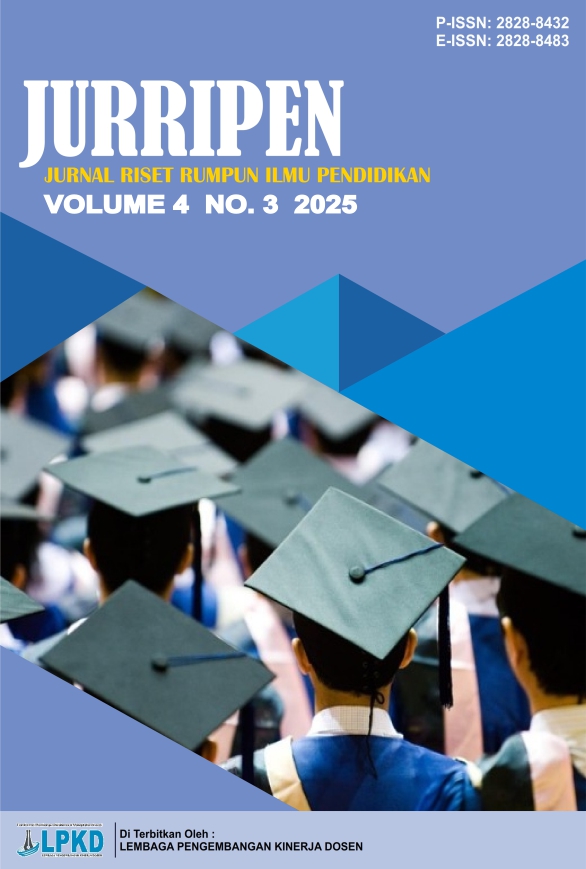
Between Assistance and Anxiety: How AI Impacts Writing Stress among EFL English Literature Majors
DOI:
https://doi.org/10.55606/jurripen.v4i3.7012Keywords:
Academic Integrity, AI Writing Tools, EFL Learners, Self-Efficacy, Writing AnxietyAbstract
This research explores the dual impact of Artificial Intelligence (AI) on the academic writing experiences of English Literature students learning English as a Foreign Language (EFL). AI tools like ChatGPT, Grammarly, and QuillBot are commonly used for grammar correction and sentence construction. These tools are integrated into students' writing processes, providing valuable assistance in refining their written work. However, their psychological effects, particularly in terms of emotional and ethical implications, have not been sufficiently explored in previous research. This study employed a qualitative phenomenological approach, utilizing Interpretative Phenomenological Analysis (IPA), to examine the experiences of ten final-year EFL students who actively use AI tools for academic writing. Through semi-structured interviews, the research identified three major themes: reduced technical stress, heightened dependency on AI tools, and ethical concerns about authorship. The findings suggest that while AI tools act as cognitive scaffolds, aiding students by improving fluency and reducing the burden of technical writing tasks, they also introduce psychological challenges. These challenges include increased dependency on the tools and concerns about the authenticity of their work, raising questions about academic integrity and self-efficacy. This study sheds light on the complex relationship between AI as an assistive technology and its potential to cause writing anxiety and dependency. By emphasizing both the positive and negative psychological impacts of AI, the study contributes to the growing body of literature on AI in education. It calls for the development of pedagogical frameworks that balance AI literacy, emotional resilience, and ethical considerations to ensure responsible and effective use of AI in academic contexts.
Downloads
References
Boillos, D. (2025). Emotion regulation strategies in technology-mediated writing: An affective study of AI tool use. Journal of Language Psychology, 12(1), 14–29. https://doi.org/10.1016/j.jlp.2025.01.004
Candilas, R., Moeljadi, D., & Setiawan, B. (2024). AI, writing, and EFL: Navigating psychological complexity in higher education. TESOL Quarterly, 58(2), 233–250. https://doi.org/10.1002/tesq.3280
Cheng, Y. S. (2004). A measure of second language writing anxiety: Scale development and preliminary validation. Journal of Second Language Writing, 13(4), 313–335. https://doi.org/10.1016/j.jslw.2004.07.001
He, J., Zhang, Y., & Li, F. (2025). AI and the self-efficacy crisis: A qualitative inquiry in the EFL context. Computers & Education, 204, 105335. https://doi.org/10.1016/j.compedu.2025.105335
Horwitz, E. K. (2016). Foreign and second language anxiety. Language Teaching, 49(1), 112–126. https://doi.org/10.1017/S0261444814000383
Hyland, K. (2019). Second language writing. Cambridge University Press.
Krashen, S. D. (1982). Principles and practice in second language acquisition. Pergamon Press.
Lee, M., & Chen, H. (2023). The cost of convenience: Overreliance on AI in academic writing. Language Learning & Technology, 27(1), 66–84. https://doi.org/10.1016/llt.2023.01.005
Li, X., & Lei, L. (2023). Intelligent writing assistants and the development of EFL students’ writing skills: A meta-analysis. System, 112, 102947. https://doi.org/10.1016/j.system.2023.102947
Lin, Y., & Huang, W. (2022). AI tools in EFL classrooms: Enhancing accuracy and reducing writing anxiety. CALL-EJ, 23(2), 45–60.
Lincoln, Y. S., & Guba, E. G. (1985). Naturalistic inquiry. Sage Publications.
Rezaei, M., & Jafari, M. (2022). Foreign language writing anxiety and its impact on writing performance: A study among Iranian EFL students. Language Testing in Asia, 12(1), 17–31. https://doi.org/10.1186/s40468-022-00167-1
Smith, J. A., Flowers, P., & Larkin, M. (2009). Interpretative phenomenological analysis: Theory, method and research. Sage.
Sun, Y., & Zhang, W. (2023). Digital feedback tools and their role in reducing EFL writing anxiety: Evidence from higher education. Educational Technology & Society, 26(1), 52–64.
Xiaofan, L. (2025). Reconsidering the role of AI in creative academic expression: Insights from EFL learners. ELT Journal, 79(1), 13–28. https://doi.org/10.1093/elt/ccad021
Zhang, W., & Hyland, K. (2023). Artificial intelligence and the future of academic authorship in EFL contexts. Journal of Second Language Writing, 60, 101851. https://doi.org/10.1016/j.jslw.2023.101851
Zhao, S., & Wang, L. (2021). Perceived benefits and risks of AI writing assistants: Insights from Chinese EFL students. ReCALL, 33(3), 220–237. https://doi.org/10.1017/S0958344021000091
Zhou, X., & Lin, J. (2020). Students’ attitudes toward AI-supported writing tools in university EFL courses. Language Learning & Technology, 24(3), 30–45.
Downloads
Published
How to Cite
Issue
Section
License
Copyright (c) 2025 JURNAL RISET RUMPUN ILMU PENDIDIKAN

This work is licensed under a Creative Commons Attribution-ShareAlike 4.0 International License.
_001.jpg)