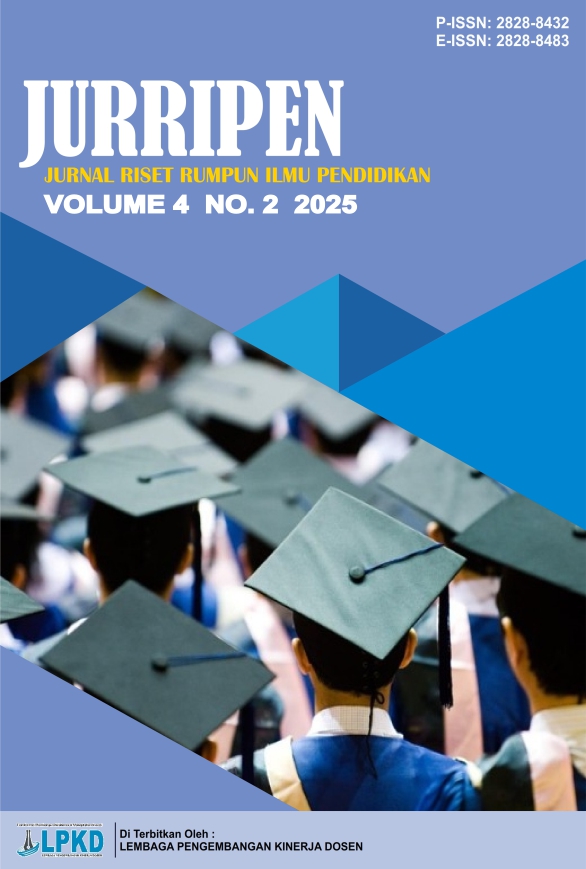
Exploring The Use of Podcasts as Learning Media in Enhancing Listening Skills: EFL Students' Perceptions
DOI:
https://doi.org/10.55606/jurripen.v4i2.5613Keywords:
EFL listening class, EFL students, Listening comprehension, Listening skills, Podcasts as learning mediaAbstract
This study explores EFL students’ perceptions of podcasts media used by English teachers in teaching listening comprehension at an Islamic Senior High School in Palangka Raya, Central Kalimantan, Indonesia. Using a case study design, data were collected from 27 tenth-grade students who enrolled in a listening class through questionnaires, semi-structured interviews, observation, and documentation. The quantitative data obtained from the questionnaire were analyzed using descriptive statistical analysis, while data obtained from the interviews, observations, and documentations were analyzed thematically. The findings show that students generally held positive perceptions toward podcasts as learning media in enhancing their listening skills. Despite initial difficulties such as understanding native speakers’ accents, rapid speech, and limited vocabulary, students overcame these challenges using strategies like repetition, subtitles, note-taking, and translation tools. Podcasts were also used to support improvements in pronunciation, vocabulary, and overall listening comprehension. Students also appreciated the flexibility, accessibility, and engaging content that podcasts offer, which enhanced their motivation in learning. However, some obstacles, such as a lack of consistency and motivation, were also reported. Still, students developed adaptive strategies to stay engaged. This study concludes that podcast media can be an effective tool for improving EFL students’ listening skills when integrated with proper guidance and regular practice. The findings highlight the potential of podcasts as a supportive and accessible medium in English language instruction, specifically to foster students' listening skills.
Downloads
References
Abdous, M., Facer, B. R., & Yen, C.-J. (2012). Academic effectiveness of podcasting: A comparative study of integrated versus supplemental use of podcasting in second language classes. Computers & Education, 58(1), 43–52. https://doi.org/10.1016/j.compedu.2011.08.021
Abdulrahman, T. R., Basalama, N., & Widodo, M. R. (2018). The impact of podcasts on EFL students’ listening comprehension. International Journal of English Linguistics, 8(6), 122–135. https://doi.org/10.5539/ijel.v8n6p122
Ahmad, I., & Abidin, M. J. Z. (2020). Developing an alternative listening comprehension test to benchmark Malaysian undergraduates’ listening performances. International Journal of Instruction, 13(2), 677–690. https://doi.org/10.29333/iji.2020.13246a
Alfa, R. R. (2020). Using podcasts as authentic material to develop students’ speaking skills. JELLT Journal of English Language and Language Teaching, 4(1), 65–74. https://doi.org/10.36597/jellt.v4i1.7692
Alfian, Lio, A., & Marafat, L. (2019). The use of audio podcasts for teaching listening comprehension. Journal of Language Education and Educational Technology, 4(1), 1–12. http://dx.doi.org/10.33772/jleet.v4i1.6671
Al-Mohawes, N. K. M. (2023). The impact of using a podcast episodic series of spoken-word digital audio on improving Imam University EFL beginners' listening skills (Master’s thesis, Imam Muhammad Ibn Saud Islamic University). Department of English Language and Literature, College of Languages and Translation. https://dx.doi.org/10.24093/awej/th.298
Arslan, G., & Çifçi, S. (2024). The use of podcasts in enhancing discriminative listening skills of Turkish learners abroad: A1 level. International Journal of Education & Literacy Studies, 12(1), 33–47. https://doi.org/10.7575/aiac.ijels.v.12n.1p.44
Baguley, T. (2009). Standardised or simple effect size: What should be reported? British Journal of Psychology, 100(3), 603–617. https://doi.org/10.1348/000712608X377117
Becker, A. (2016). L2 studies’ performance listening comprehension items targeting local and global information. Journal of English for Academic Purposes, 24, 1–13. https://doi.org/10.1016/j.jeap.2016.07.004
Carson, L., Hontvedt, M., & Lund, A. (2021). Student teacher podcasting: Agency and change. Learning, Culture and Social Interaction, 29, 100514. https://doi.org/10.1016/j.lcsi.2021.100514
Creswell, J. W. (2009). Research design: Qualitative, quantitative, and mixed methods approaches (3rd ed.). SAGE.
Hasanah, A., Adawiyah, A., Nurfajrin, D., & Musni, M. F. (2021). Podcast media as a line learning alternative and stimulation of student language skills. Jurnal Mercatoria, 1(1), 174–200. https://doi.org/10.35194/cp.v0i0.1358
Hendrawaty, N. (2019). The influence of listening to English pop songs on improving learners’ vocabulary at LKP Nuansa Jaya. Loquen: English Studies Journal, 12(1), 56–70. https://doi.org/10.32678/loquen.v12i01.1192
Namaziandost, E., Neisi, L., Mahdavirad, F., & Nasri, M. (2019). The relationship between listening comprehension problems and strategy usage among advanced EFL learners. Cogent Psychology, 6(1). https://doi.org/10.1080/23311908.2019.1691338
Rahman, A., Atmowardoyo, H., & Salija, K. (2018). Podcast effects on EFL learner listening. ELT Worldwide: Journal of English Language Teaching, 5(2), 151–170. https://doi.org/10.26858/eltww.v5i2.7374
Samuel-Azran, T., Laor, T., & Tal, D. (2019). Who listens to podcasts, and why? The Israel case. Online Information Review, 43(4), 482–495. https://doi.org/10.1108/OIR-04-2017-0119
Starkey, L. (2020). A review of research exploring teacher preparation for the digital age. Cambridge Journal of Education, 50(1), 37–56. https://doi.org/10.1080/0305764X.2019.1625867
Syahabuddin, K., & Rizqa, K. (2021). Improving students’ listening skills using podcasts. Journal of Digital Education, Communication, and Arts (DECA), 4(1), 51–61. https://doi.org/10.30871/deca.v4i01.2867
Yin, R. K. (2018).
Downloads
Published
How to Cite
Issue
Section
License
Copyright (c) 2025 JURNAL RISET RUMPUN ILMU PENDIDIKAN

This work is licensed under a Creative Commons Attribution-ShareAlike 4.0 International License.
_001.jpg)