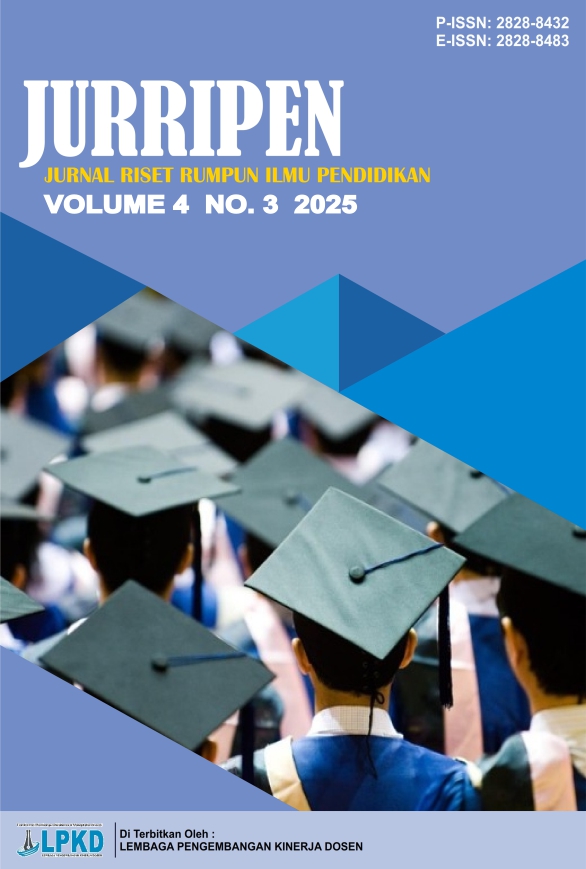
The Effect of Gadget Addiction on the Ability to Read the Qur'an Among Students at Islamic Junior High Schools in Cirebon Regency
DOI:
https://doi.org/10.55606/jurripen.v4i3.6874Keywords:
Al-Qur'an, Cirebon, Gadget Addiction, Madrasah Tsanawiyah, StudentsAbstract
In the era of globalization, the widespread use of digital gadgets has significantly influenced students’ daily lives, including their learning processes. This study aims to evaluate the prevalence of gadget addiction among students at Madrasah Tsanawiyah (MTS) and to examine its potential impact on their ability to recite the Qur’an. A quantitative approach with a correlational research design was employed to identify the association between gadget addiction and Qur’an reading proficiency. The participants consisted of 122 students selected through convenience sampling from one MTS institution in Cirebon Regency. The instrument for measuring gadget addiction contained 11 items, while the Qur’an reading ability test consisted of 12 items, with a reliability coefficient of 0.593. Data analysis included descriptive statistics to describe the distribution of scores and inferential statistics, specifically the correlation test, to determine the relationship between the two variables. The results revealed that 77% of students experienced a high level of gadget addiction, while 15% demonstrated low levels, and 8% fell into the moderate category. In terms of Qur’an recitation ability, 63% of the students were classified in the low category, 35% in the moderate category, and only 2% in the high category. The correlation analysis produced a coefficient of -0.544**, indicating a moderately strong negative relationship between gadget addiction and Qur’an reading ability (range 0.400–0.599). The two-tailed significance value (p = 0.000 < 0.05) confirmed the statistical significance of this finding. Overall, the study highlights that greater gadget addiction is associated with lower Qur’an reading proficiency, whereas lower levels of gadget use are linked to improved recitation skills. These findings suggest the urgent need for educational interventions and parental guidance to balance gadget usage and ensure the strengthening of Qur’anic literacy among students.
Downloads
References
Agostini, D., & Petrucco, C. (2023). Problematic smartphone use and university students' academic performance. Journal of E-Learning and Knowledge Society.
Ahn, J. S., Jeong, I. J., Park, S., Lee, J., Jeon, M., Lee, S., Do, G., Jung, D., & Park, J. Y. (2025). App-based ecological momentary assessment of problematic smartphone use during examination weeks in university students: 6-week observational study. Journal of Medical Internet Research, 27. https://doi.org/10.2196/69320
Ammunje, R. N., Prabhu, M. H., & Barkur, G. (2023). Smartphones and academic performance: Evidence from India. Interactive Technology and Smart Education, 20(2), 161–176. https://doi.org/10.1108/ITSE-11-2021-0204
Bandura, A. (1978). Self-efficacy: Toward a unifying theory of behavioral change. Advances in Behaviour Research and Therapy, 1(4), 139–161. https://doi.org/10.1016/0146-6402(78)90002-4
Creswell, J. W. (2015). Riset perencanaan, dan evaluasi riset kualitatif dan kuantitatif pendidikan. Yogyakarta, Indonesia: Pustaka Pelajar.
Esan, D. T., Olawade, D. B., Atule, I. F., Emetere, M., David-Olawade, A. C., Ramos, C. G., & Esan, T. O. (2025). The impact of smartphone use on learning effectiveness: A case study of college students. The Open Public Health Journal, 18(1). https://doi.org/10.2174/0118749445381116250318054244
Fauzi, M. R., & Rahman, A. (2020). Pengaruh penggunaan gadget terhadap kemampuan membaca Al-Qur'an santri di Pondok Pesantren Modern Al-Ihsan. Jurnal Pendidikan Islam, 15(2), 145–162.
Gagné, R. (2010). The conditions of learning and theory of instruction. Elementary Education Online, 9(93), 5–9.
Habib, M. A. (2019). Internet addiction: The emergence of a new clinical disorder. Anwer Khan Modern Medical College Journal, 10(2), 103–104. https://doi.org/10.3329/akmmcj.v10i2.44116
Hidayat, S. (2019). Dampak kecanduan gadget terhadap kemampuan menghafal Al-Qur'an pada siswa madrasah. Jurnal Studi Islam, 8(3), 78–95.
I. N. P., Suwindra, Darmawiguna, I. G. M., & Ermawan, D. K. T. (2025). Effectiveness of a personal pulse agent (PPA) application development for smartphone users. ARPN Journal of Engineering and Applied Sciences, 587–595. https://doi.org/10.59018/052574
Karunakaran, R., & Selvabaskar, S. (2022). Drivers of zoomers' OTT consumption - Uses gratifications theory approach. 2022 International Conference for Advancement in Technology (ICONAT). https://doi.org/10.1109/ICONAT53423.2022.9726064
Kustiyahningsih, Y., & Aini, I. Q. H. (2020). Integration of FAHP and COPRAS method for new student admission decision making. In Proceedings of the 2020 3rd International Conference on Vocational Education and Electrical Engineering (ICVEE). https://doi.org/10.1109/ICVEE50212.2020.9243260
Kuznekoff, J. H., & Titsworth, S. (2013). The impact of mobile phone usage on student learning. Communication Education, 62(3), 233–252. https://doi.org/10.1080/03634523.2013.767917
Mateus, J. C., Leon, L., & Vásquez-Cubas, D. (2023). Applications of the uses and gratifications theory in communication research: A systematized review. Observatorio, 17(3), 149–170. https://doi.org/10.15847/OBSOBS17320232327
Monteiro, A. P., Sousa, M., & Correia, E. (2020). Addiction to the internet and personality characteristics: A study with Portuguese university students. Revista Portuguesa de Educação, 33(2), 159–176. https://doi.org/10.21814/RPE.17699
Munawaroh, A., Munawir, & Pavytha, V. (2023). Kurangnya minat remaja dalam belajar Al-Qur'an akibat pengaruh canggihnya teknologi informasi. Al-Mau'izhoh, 5(2), 460–475. https://doi.org/10.31949/am.v5i2.7535
Rosen, L. D., Carrier, L. M., & Cheever, N. A. (2013). Facebook and texting made me do it: Media-induced task-switching while studying. Computers in Human Behavior, 29(3), 948–958. https://doi.org/10.1016/j.chb.2012.12.001
Setiadi, R., Tini, E. S., & Kalsum, U. (2019). The risk of smartphone addiction to emotional mental disorders among junior high school students. Belitung Nursing Journal, 5(5), 197–203. https://doi.org/10.33546/bnj.841
Sweller, J. (1988). Cognitive load during problem solving: Effects on learning. Cognitive Science, 12(2), 257–285. https://doi.org/10.1016/0364-0213(88)90023-7
Syamsul, A., Huda, M., & Hayati, M. N. (2023). Developing akhlak karimah values through integrative learning model in madrasah. Jurnal Pendidikan Islam, 9(1), 41–54. https://doi.org/10.15575/jpi.v0i0.24443
Tang, W. L., Tsai, J. T., & Huang, C. Y. (2020). Inheritance coding with Gagné-based learning hierarchy approach to developing mathematics skills assessment systems. Applied Sciences, 10(4), 1465. https://doi.org/10.3390/app10041465
Ward, A. F., Duke, K., Gneezy, A., & Bos, M. W. (2017). Brain drain: The mere presence of one’s own smartphone reduces available cognitive capacity. Journal of the Association for Consumer Research, 2(2), 140–154. https://doi.org/10.1086/691462
Young, K. S. (1998). Internet addiction: The emergence of a new clinical disorder. Cyberpsychology & Behavior, 1(3), 237–244. https://doi.org/10.1089/cpb.1998.1.237
Downloads
Published
How to Cite
Issue
Section
License
Copyright (c) 2025 JURNAL RISET RUMPUN ILMU PENDIDIKAN

This work is licensed under a Creative Commons Attribution-ShareAlike 4.0 International License.
_001.jpg)