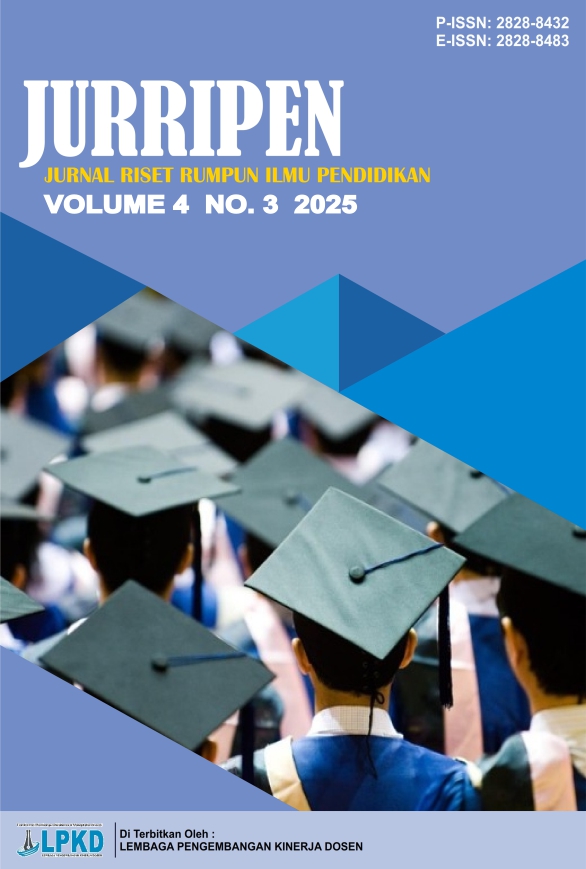
Hubungan Antara Motivasi Belajar dan Kepatuhan Mengumpulkan PR pada Anak Kelas IV Dan V di SD Negeri 104237 Dalu Sepuluh B
DOI:
https://doi.org/10.55606/jurripen.v4i3.6744Keywords:
Cottage Activities, Homework, Learning Motivation, Student Discipline, Teacher InteractionAbstract
This research is driven by the low level of student motivation in completing homework at SD Negeri 104237 Dalu Sepuluh B. Motivation serves as a key factor that encourages students to be enthusiastic about learning. This study applies a descriptive qualitative method, which aims to present events or facts as they occur in the field, where the researcher acts as the main instrument in the process. Data were collected through observation, interviews, and documentation. The findings reveal that students’ motivation to do homework at SD Negeri 104237 Dalu Sepuluh B is relatively low. This is reflected in the first indicator, namely the willingness to make efforts despite repeated failures, where students appear indifferent toward homework assignments. The second indicator concerns the habit of completing homework early, which shows that students rarely work on assignments and only do so when they have spare time. The third indicator is activeness during lessons, where students are less engaged in responding to teachers, resulting in minimal interaction between students and teachers in the classroom, and their attention to lessons is limited. The fourth indicator relates to punctuality in submitting homework, as students are less disciplined in turning in assignments, often prioritizing tasks from the Islamic boarding school. The main inhibiting factor of students’ motivation in doing homework is the busy schedule of boarding school activities, which makes it difficult for students to manage their time to complete assignments.
Downloads
References
Andriani, R. (2019). Motivasi belajar sebagai determinan hasil belajar siswa. Jurnal Pendidikan Mandala, 4(1), 80–86. https://doi.org/10.17509/jpm.v4i1.14958
Awe, E. Y., & Benge, K. (2017). Hubungan antara minat dan motivasi belajar dengan hasil belajar pada siswa SD. Journal of Education Technology, 1(4), 231. https://doi.org/10.23887/jet.v1i4.12859
Damayanti, M. (2017). Pengaruh pemberian tugas terstruktur dengan umpan balik individual terhadap hasil belajar siswa. Saintifik, 2(1), 46–53. https://doi.org/10.31605/saintifik.v2i1.95
Darmawan, H., Kartika, E., Pendidikan Fisika, P., PGRI Pontianak, I., & Ampera No, J. (2017). Pengaruh pemberian direct corrective feedback pada pekerjaan rumah terhadap hasil belajar siswa. Jurnal Pendidikan Informatika Dan Sains, 6(1), 1–7. Retrieved from http://www.journal.ikippgriptk.ac.id/index.php/saintek/article/view/482
Dewi, R., & Saputra, M. (2021). Faktor-faktor yang mempengaruhi motivasi belajar siswa di SD Negeri 01 Bandung. Jurnal Pendidikan Indonesia, 6(3), 78–85. https://journal.upi.edu/jpi/article/view/6789
Emda, A. (2018). Kedudukan motivasi belajar siswa dalam pembelajaran. Lantanida Journal, 5(2), 172. https://doi.org/10.22373/lj.v5i2.2838
Fitria, N., & Ramadhan, M. (2023). Motivasi belajar dan pengaruhnya terhadap disiplin siswa SD. Jurnal Kajian Pendidikan, 7(2), 55–62. https://journal.isi.ac.id/index.php/jkp/article/view/23789
Kartika, E., & Ampera, J. (2020). Strategi guru dalam meningkatkan motivasi belajar siswa Sekolah Dasar. Jurnal Pendidikan dan Kebudayaan, 12(1), 25–34. https://ejournal.kemdikbud.go.id/index.php/jpk/article/view/30098
Lestari, D. P. (2021). Pengaruh pengelolaan waktu belajar terhadap motivasi dan prestasi belajar siswa SD. Jurnal Pendidikan Mandala, 8(1), 44–53. https://ojs.unm.ac.id/index.php/jpm/article/view/5432
Maulana, O. (2017). Peningkatan hasil belajar pendidikan agama Islam melalui strategi kooperatif tipe jigsaw.
Murapi, I., Yogha, F., Dwiana, S., Universitas, A., & Mataram, B. (2020). Pengaruh pemberian tugas rumah terhadap hasil belajar siswa. Jurnal Pendidikan, 1(2), 1–10.
Prasetyo, B. A., & Wijayanti, L. P. (2024). Hubungan motivasi belajar dengan disiplin belajar siswa sekolah dasar. Jurnal Ilmiah Pendidikan, 10(2), 67–76. https://jurnal.dikdasmen.kemdikbud.go.id/index.php/jurnalilmiahpendidikan/article/view/abcde
Sari, M., & Sunarno, N. (2018). Faktor-faktor yang mempengaruhi motivasi belajar siswa SD. Jurnal Pendidikan Guru Sekolah Dasar, 4(2), 71–78. https://journal.uns.ac.id/jurnal-pgsd/article/view/3456
Susanti, D. (2023). Pengaruh motivasi belajar terhadap prestasi belajar siswa di Sekolah Dasar. Jurnal Pendidikan Dasar Indonesia, 8(1), 45–53. https://ejournal.unesa.ac.id/index.php/jpdi/article/view/12345
Wahyuni, S., & Hasanah, U. (2022). Pengaruh pemberian tugas rumah terhadap motivasi belajar siswa. Jurnal Pendidikan dan Pembelajaran, 9(1), 34–42. https://journal.unnes.ac.id/sju/index.php/jpp/article/view/3947
Wibowo, A., & Suroso. (2016). Adversity quotient, self-efficacy, dan kesiapan kerja siswa kelas XII program keahlian multimedia SMKN 1 Kabupaten Jombang. Persona: Jurnal Psikologi Indonesia, 5(2), 174–180.
Yan Tian, X. F. (2014). Adversity quotients, environmental variables and career adaptability in student nurses. Journal of Vocational Behavior, 85(3), 251–257. https://doi.org/10.1016/j.jvb.2014.07.006
Zhao, Y., & Sang, B. (2023). The role of emotional quotients and adversity quotients in career success. Frontiers in Psychology, 14, 1128773.
Downloads
Published
How to Cite
Issue
Section
License
Copyright (c) 2025 JURNAL RISET RUMPUN ILMU PENDIDIKAN

This work is licensed under a Creative Commons Attribution-ShareAlike 4.0 International License.
_001.jpg)