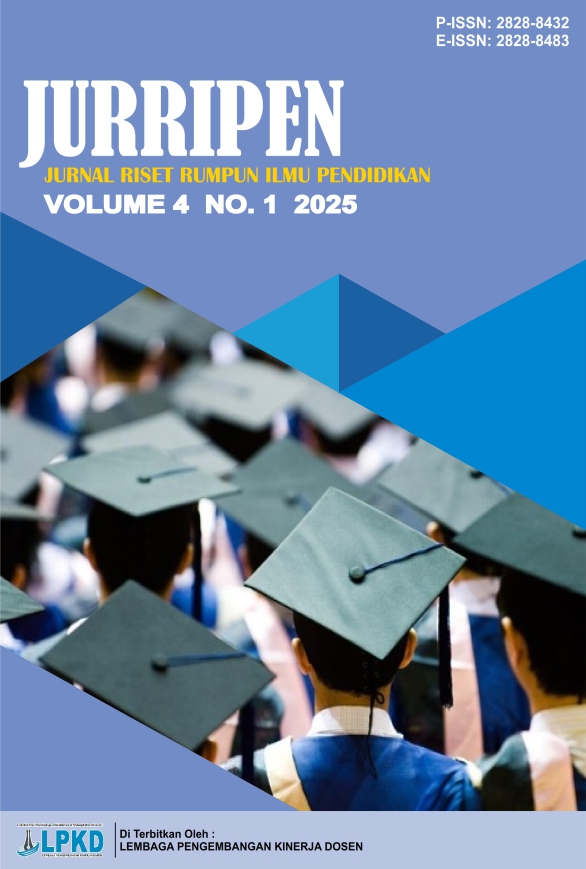
Manajemen Adversity Quotient dalam Meningkatkan Kinerja dan Profesionalisme Guru di Kotabaru
DOI:
https://doi.org/10.55606/jurripen.v4i1.6264Keywords:
Adversity Quotient, Teacher Professionalism, School Management, Psychological Resilience, Teacher Performance, Qualitative ApproachAbstract
The increasing workload and pressure in the field of education necessitate effective Adversity Quotient (AQ) management to foster teacher resilience and uphold professionalism amid evolving challenges. This study aims to analyze how AQ management contributes to enhancing teacher performance and professionalism. In the face of continuous educational change, teachers are exposed to various pressures, including administrative burdens, curricular dynamics, and complex social expectations. AQ which consists of four core dimensions: Control, Ownership, Reach, and Endurance is considered a crucial factor influencing psychological resilience and professional consistency. This research employs a descriptive qualitative approach to explore managerial strategies, teacher perceptions, and experiences in developing AQ within the school environment. Data were collected through in-depth interviews, observations, and documentation. The findings reveal that AQ is managed through contextual and participatory approaches, supported by an open organizational culture, supportive leadership, and a psychosocially healthy work environment. Strengthening AQ has been shown to contribute to the development of adaptive, reflective, and professional educators. Therefore, integrating AQ into ongoing professional development programs is recommended as a strategic institutional response to the growing complexities of the educational landscape.
Downloads
References
Alfaruqy, M. Z., Sari, I. A., & Safuroh, S. (2023). Hubungan dukungan sosial orang tua dan adversity quotient dengan motivasi belajar pada siswa kelas 7 SMP Negeri 1 Baturetno. JKKP (Jurnal Kesejahteraan Keluarga dan Pendidikan), 10(1), 38–50. https://doi.org/10.21009/jkkp.101.04
Darmadi, H., & Mm, M. M. (2018). Guru Jembatan Revolusi. CV Kekata Group.
Efendi, N., & Sholeh, M. I. (2023). Manajemen pendidikan dalam meningkatkan mutu pembelajaran. Academicus: Journal of Teaching and Learning, 2(2), 68–85. https://doi.org/10.59373/academicus.v2i2.25
https://ejournal-pasca.undiksha.ac.id/index.php/jurnal_ap/article/view/963/714
Kamilah, S., & Asni, A. (2024). Efektivitas layanan bimbingan kelompok dengan teknik problem solving untuk meningkatkan adversity quotient pada siswa sekolah menengah pertama (SMP). G-Couns: Jurnal Bimbingan dan Konseling, 8(2), 1233–1242. https://doi.org/10.31316/gcouns.v8i2.5015
Puspasari, D. A., Kuwato, T., & Wijaya, H. E. (2021). Dukungan sosial dan adversity quotient pada remaja yang mengalami transisi sekolah. Psikologika: Jurnal Pemikiran dan Penelitian Psikologi, 17(1), 69–76. https://doi.org/10.20885/psikologika.vol17.iss1.art8
Ratnamurni, E. D., Hastuti, S., Lestari, D., Septiarini, E., & Rahardianto, R. (2025). Peningkatan motivasi belajar melalui adversity quotient siswa SMAN 1 Cimahi. Jurnal Abdimas Kartika Wijayakusuma, 6, 390–401. https://doi.org/10.26874/jakw.v6i1.661
Stoltz, P. G. (1997). Adversity quotient: Turning obstacles into opportunities. John Wiley & Sons.
Sukardewi, N., Dantes, N., & Natajaya, N. (2021). Kontribusi adversity quotient, etos kerja, dan budaya organisasi terhadap kinerja guru SMA Negeri di Kota Amlapura. E-Journal Program Pascasarjana Universitas Pendidikan Ganesha, 4(2), 1–12.
Suryadi, F., Pasaribu, M. H., Siahaan, A. D., & Lubis, Y. (2024). Peran manajemen pendidikan dalam mewujudkan sekolah berkualitas. Inspirasi Dunia: Jurnal Riset Pendidikan dan Bahasa, 3(4). https://doi.org/10.58192/insdun.v3i4.2617
Tilova, N. (2021). Meninjau kinerja guru Islam: Adversity quotient dan spiritual quotient. Scientific Journal of Reflection, 2(2), 211–220. https://doi.org/10.5281/zenodo.2628088
Utami, S., Nashori, F., & Rachmawati, M. A. (2021). Pengaruh pelatihan adversity quotient untuk meningkatkan motivasi belajar siswa sekolah menengah pertama. Jurnal Intervensi Psikologi (JIP), 6(1), 131–149. https://doi.org/10.20885/intervensipsikologi.vol6.iss1.art9
Downloads
Published
How to Cite
Issue
Section
License
Copyright (c) 2025 JURNAL RISET RUMPUN ILMU PENDIDIKAN

This work is licensed under a Creative Commons Attribution-ShareAlike 4.0 International License.

_001.jpg)