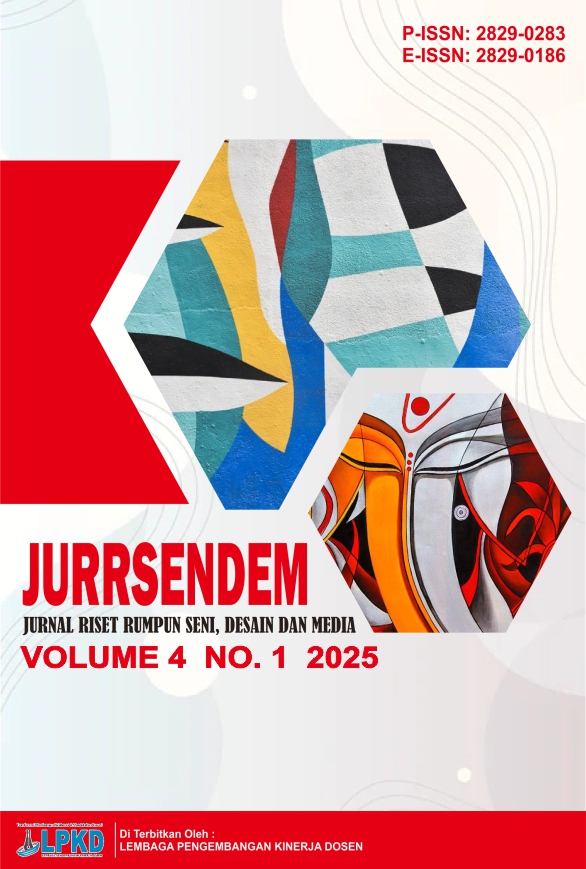
Makna Simbolik Tari Panji Kahirupan di Kabupaten Cirebon
DOI:
https://doi.org/10.55606/jurrsendem.v4i1.6272Keywords:
Panji Kahirupan Dance, Symbolic Meaning, Topeng CirebonAbstract
Panji Kahirupan Dance is a Cirebonese mask dance created by H. Taufik Hidayat, the founder of Sanggar Ki Bagus Rangin. This dance portrays the journey of human life, from pre-birth to adulthood, inspired by the changing characters (wanda) of the Cirebon mask tradition. This study aims to describe and analyze the symbolic meanings embedded in the Panji Kahirupan Dance. The research uses a qualitative method with a semiotic approach, allowing the researcher to explore both the denotative and connotative meanings of the symbolic elements in the dance. Data were collected through observation, interviews, and documentation, and validated using triangulation of techniques and sources. The data analysis involves data reduction to select relevant information, data presentation to synthesize findings, and conclusion drawing to interpret the symbolic meanings of each performance element. The costumes carry symbolic meanings through their colors: white represents the sanctity of life’s beginning, yellow symbolizes spirit, and red denotes ambition. The soft gamelan music contributes to a spiritual and contemplative atmosphere. The floor patterns, such as circles and straight lines, symbolize the life cycle and life’s purpose.
Downloads
References
Astuti, W. (2022). Makna simbolik dalam pertunjukan Tari Topeng Panji gaya Losari. Jurnal Seni Pertunjukan Indonesia, 8(1), 45–56.
Barthes, R. (1977). Image, music, text. Fontana Press.
Cirebon, D. K., & P. K. (2023). Tari Topeng Panji, jejak kehidupan dalam gerak.
Hadi, Y. S. (2005). Etnokoreologi: Telaah konsep dan metode. Pustaka Book Publisher.
Hidayat, T. (2018). Makna simbolik Tari Topeng Panji Kahirupan. Sanggar Ki Bagus Rangin.
Kaeppler, A. L. (1978). Dance in anthropological perspective. Annual Review of Anthropology, 7(1), 31–49.
Kartini, S. (2020). Filosofi dan nilai dalam Tari Topeng Cirebon. Remaja Rosdakarya.
Kurniawati, D. (2021). Tari Topeng Panji sebagai representasi filosofi kehidupan dalam budaya Cirebon. Jurnal Ilmu Budaya, 14(2), 78–89.
Moleong, L. J. (2017). Metodologi penelitian kualitatif (Edisi Revisi). Remaja Rosdakarya.
Nurhadi, A. (2015). Simbol dan makna dalam seni tari. Gramedia Pustaka Utama.
Pebianti, S. I. (2013). Makna simbolik Tari Bedhaya Tunggal Jiwa. Harmonia: Journal of Arts Research and Education, 13(2), 120–131. https://doi.org/10.15294/harmonia.v13i2.2778
Saputri, A. H. (2021). Pelatihan pembuatan video tutorial gerak tari tradisi Lampung sebagai media pembelajaran bagi guru seni budaya SMP di Kabupaten Lampung Timur. Jurnal Sumbangsih, 2(1), 197–203. https://doi.org/10.23960/jsh.v2i1.44
Saputri, R. (2021). Pemaknaan simbolik dalam pertunjukan Tari Topeng Cirebon di Sanggar Ki Bagus Rangin. In Prosiding Seminar Nasional Seni dan Budaya Nusantara.
Soedarsono. (2012). Pengantar teori tari. Pustaka Pelajar.
Sulastri, D., & Rahayu, N. (2022). Pendekatan kualitatif dalam penelitian seni pertunjukan tradisional. Jurnal Humaniora Budaya, 8(1), 45–57. https://doi.org/10.1234/jhb.v8i1.567
Wulandari, A. (2023). Analisis makna simbolik dalam tari tradisional: Studi semiotika Tari Panji. Jurnal Seni dan Makna, 5(2), 110–121. https://doi.org/10.5678/jsm.v5i2.890
Downloads
Published
How to Cite
Issue
Section
License
Copyright (c) 2025 Jurnal Riset Rumpun Seni, Desain dan Media

This work is licensed under a Creative Commons Attribution-ShareAlike 4.0 International License.