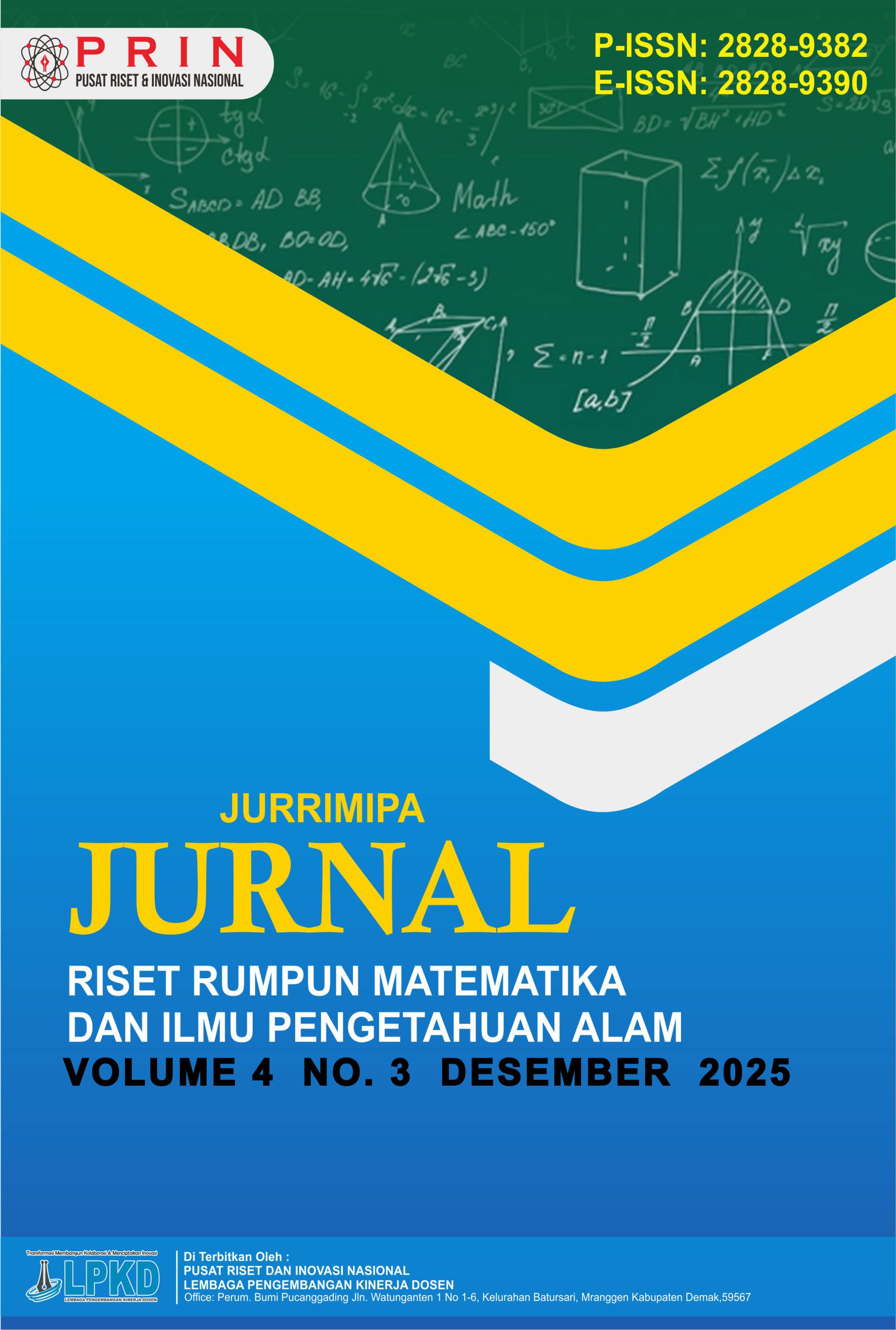
Peran Logika dalam Pembelajaran Matematika: Pengenalan Konsep Pembuktian Sejak Awal
DOI:
https://doi.org/10.55606/jurrimipa.v4i3.7077Keywords:
Concept of Proof, Early Childhood Education, Logic, Mathematics Learning, ReasoningAbstract
Logic is an important foundation in mathematics learning because it shapes critical and systematic thinking skills. Introducing the concept of proof early on plays a strategic role in developing reasoning skills, identifying patterns, and providing simple arguments. This article aims to examine the role of logic in mathematics learning by emphasizing the importance of introducing the concept of proof from the outset. The methods used are a literature review of various relevant studies and descriptive analysis based on learning practices in early childhood education. The results of the study show that play, exploration, and concrete experience-based learning activities can improve children's ability to understand cause-and-effect relationships, make predictions, and convey logical reasons. In addition, social interaction and dialogue in the learning process have been proven to strengthen simple reasoning skills. In conclusion, the integration of logic and reasoning from an early age not only supports the development of mathematical abilities, but also builds the foundation for critical and analytical thinking needed for further education.
Downloads
References
Clements, D. H., & Sarama, J. (2007). Early childhood mathematics learning. In F. K. Lester (Ed.), Second handbook of research on mathematics teaching and learning (Vol. 2, pp. 461–555). Information Age Publishing.
Creswell, J. W. (2014). Research design: Qualitative, quantitative, and mixed methods approaches (4th ed.). Sage Publications.
Denzin, N. K. (2012). The research act: A theoretical introduction to sociological methods. Routledge.
Fatimah, S., & Nusantara, T. (2021). Pengembangan kemampuan berpikir logis melalui permainan tradisional pada anak usia dini. Jurnal Obsesi: Jurnal Pendidikan Anak Usia Dini, 5(2), 1234–1245.
Hasanah, U., & Wijayanti, A. (2023). Pengaruh penggunaan media pembelajaran berbasis teknologi terhadap kemampuan berpikir logis siswa sekolah dasar. Jurnal Inovasi Pendidikan dan Pembelajaran, 7(3), 201–210. https://doi.org/10.58258/jupe.v7i2.3849
Khasanah, I. (2013). Strategi guru dalam mengembangkan logika matematika anak usia dini di TK Ikal Bulog Jakarta Timur. Jurnal Penelitian PAUDIA, 2(1), 11–20. https://doi.org/10.26877/paudia.v1i1.261
Kurniawan, A., & Putri, R. I. I. (2023). Pengembangan instrumen penilaian kemampuan berpikir kreatif matematis siswa sekolah dasar. Jurnal Kreano: Jurnal Matematika Kreatif-Inovatif, 14(2), 156–167.
Maghfiroh, I., & Sulianto, J. (2025). Mengembangkan penalaran dan pembuktian matematika pada anak usia dini melalui aktivitas bermain dan eksplorasi. Edukasi dan Didaktika, 3(1), 10–20.
Miles, M. B., & Huberman, A. M. (1994). Qualitative data analysis: An expanded sourcebook (2nd ed.). Sage Publications.
Piaget, J. (1964). Cognitive development in children: Piaget. Journal of Research in Science Teaching, 2(3), 176–186. https://doi.org/10.1002/tea.3660020306
Pratiwi, D. K., & Mardiyana, M. (2024). Pengembangan lembar kerja peserta didik (LKPD) berbasis problem-based learning untuk meningkatkan kemampuan berpikir kritis siswa SMP. Jurnal Pendidikan Matematika, 12(1), 78–89.
Rahmawati, I., & Suryadi, D. (2022). Analisis kemampuan pemecahan masalah matematis siswa SD melalui pendekatan realistic mathematics education (RME). Jurnal Penelitian Pendidikan, 23(1), 56–67.
Rogoff, B. (2003). The cultural nature of human development. Oxford University Press.
Setiawan, R., & Lestari, N. (2022). Pengaruh model pembelajaran kooperatif tipe STAD terhadap kemampuan berpikir logis siswa pada materi geometri. Jurnal Penelitian dan Evaluasi Pendidikan, 26(1), 89–98.
Sugiyono. (2019). Metode penelitian pendidikan: Pendekatan kuantitatif, kualitatif, dan R&D. Alfabeta.
Susanto, A., & Handayani, S. (2020). Implementasi pendekatan saintifik dalam pembelajaran matematika untuk meningkatkan kemampuan berpikir logis siswa. Jurnal Pendidikan dan Pembelajaran, 27(2), 145–156.
Trilling, B., & Fadel, C. (2009). 21st century skills: Learning for life in our times. Jossey-Bass.
Vygotsky, L. S. (1978). Mind in society: The development of higher psychological processes. Harvard University Press.
Wulandari, A., & Sutrisno, S. (2021). Analisis kesulitan siswa dalam menyelesaikan soal-soal matematika berbasis higher order thinking skills (HOTS). Jurnal Riset Pendidikan Matematika, 8(3), 234–245. https://doi.org/10.32493/jsmu.v3i2.8674
Yusoff, M., Rahman, S. A., Mutalib, S., & Mohammed, A. (2006). Diagnosing application development for skin disease using backpropagation neural network technique. Journal of Information Technology, 18, 152–159.
Zed, M. (2014). Metode penelitian kepustakaan. Yayasan Obor Indonesia.
Downloads
Published
How to Cite
Issue
Section
License
Copyright (c) 2025 JURNAL RISET RUMPUN MATEMATIKA DAN ILMU PENGETAHUAN ALAM

This work is licensed under a Creative Commons Attribution-ShareAlike 4.0 International License.