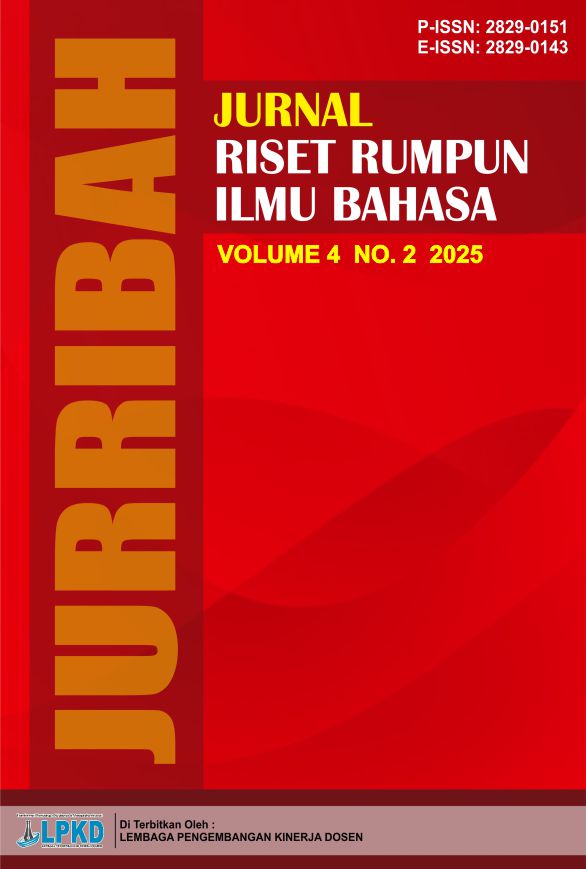
Nonverbal and Verbal Signs in the Music Video Forever Young by Alphaville (1984)
DOI:
https://doi.org/10.55606/jurribah.v4i2.5468Keywords:
Music video, Non-verbal signs, Semiotics, Verbal signsAbstract
This study is titled Nonverbal and Verbal Signs in the Music Video Forever Young by Alphaville (1984). It examines how verbal and nonverbal signs in the music video are used to represent messages about youth, time, and emotional longing through a semiotic approach. The objectives of this study are to identify the verbal and nonverbal signs used in the video and to analyze how these signs construct symbolic emotional, cultural, and philosophical meanings. The data consists of visual scenes and lyrics from the official “Forever Young” music video. Data collection was conducted through observation by listening to the song, reading the lyrics, and documenting the visuals. The analysis employs a qualitative descriptive method, applying relevant theories of meaning, visual semiotics, and color symbolism. The findings show that the music video uses a combination of affective, connotative, and conceptual meanings to convey its message. The most dominant nonverbal aspects are props, manner, and activity, while appearance and content analysis are also present with less frequency. In the verbal signs, affective and connotative meanings appear most often, reflecting strong emotional nuance and symbolic references to youth and existential reflection.
Downloads
References
Chandler, D. (2007). Semiotics: The basics (4th ed.). Routledge. https://doi.org/10.4324/9781003155744
Dewi, P. (2023). Verbal and nonverbal communication elements in As It Was music video by Harry Styles.
Dyer, G. (1982). Advertising as communication. Routledge. https://doi.org/10.4324/9780203158340
Esposito, A., Bratanić, M., & Keller, E. (2007). Fundamentals of verbal and nonverbal communication and the biometric issue. IOS Press.
Fitria, N. S. (2023). A semiotics analysis found on music video of You Belong with Me by Taylor Swift. PRAGMATICA: Journal of Linguistics and Literature, 1(1), Article 1. https://doi.org/10.60153/pragmatica.v1i1.17
Goodwin, A. (1992). Dancing in the distraction factory: Music television and popular culture. University of Minnesota Press. https://muse.jhu.edu/pub/23/monograph/book/31652
Hess, U. (2016). Nonverbal communication. In Encyclopedia of Mental Health (pp. 208–218). Elsevier. https://doi.org/10.1016/B978-0-12-397045-9.00218-4
Leech, G. N. (1981). Semantics: The study of meaning (2nd ed.). Penguin Books.
Ma, L. (2022). Research on the effect of different types of short music videos on viewers’ psychological emotions. Frontiers in Public Health, 10, 992200. https://doi.org/10.3389/fpubh.2022.992200
Niscita, B. (2022). Meaning of sign found in iPhone 13 advertisement video. https://jurnal.undhirabali.ac.id/index.php/index/search/authors/view?givenName=Ida%20Bagus%20Brian&familyName=Niscita&affiliation=&country=&authorName=Niscita%2C%20Ida%20Bagus%20Brian
Saussure, F. de. (1916). Course in general linguistics. Columbia University Press. http://books.ms/main/3656C7C3F140276E8F5A1925892D9E42
Wierzbicka, A. (1996). Semantics primes and universals. Scribd. https://www.scribd.com/embeds/476358134/content?start_page=1&view_mode=scroll&access_key=key-fFexxf7r1bzEfWu3HKwf
Yanthy, N. P. E. P., Udayana, I. N., & Rahayunu, N. K. S. (2023). Non verbal signs of Marshmello feat Bastille’s music video “Happier.” ULIL ALBAB: Jurnal Ilmiah Multidisiplin, 2(10), 4861–4885. https://doi.org/10.56799/jim.v2i10.2255
Downloads
Published
How to Cite
Issue
Section
License
Copyright (c) 2025 Jurnal Riset Rumpun Ilmu Bahasa

This work is licensed under a Creative Commons Attribution-ShareAlike 4.0 International License.